Who Owns Main Street?
By Brian Vinci
Look around the room at your next chamber or social mixer. Some of the businesses there are no longer owned by anyone in your town, and you'd have no way of knowing which ones.
Take Brevard County, on Florida's Space Coast, where I live and work. It has already seen how far that can go. In 2017, Steward Health Care, a hospital chain private equity firm Cerberus created in 2010, bought the Wuesthoff hospitals in Melbourne and Rockledge and Sebastian River Medical Center. Cerberus cashed out in 2020. Steward filed for bankruptcy in May 2024. Orlando Health bought the three hospitals out of bankruptcy for $439 million, then closed Rockledge Hospital in April 2025 because repairs would cost more than a new building. About 940 positions were eliminated, though Orlando Health guaranteed jobs elsewhere in its system to staff in good standing who were willing to move.
The story cuts both ways. A chain built by private equity ran three local hospitals into bankruptcy. A Central Florida nonprofit picked up the pieces and is reinvesting: Orlando Health committed more than $750 million to new Brevard facilities, including a seven-story hospital in Viera set to open as early as fall 2027. That is the extreme version, and most deals look nothing like it. But it shows how far from Main Street the decisions about a Main Street business can end up, and how long the community lives with them.
Most of the time it's much quieter, and it's happening all over Main Street. When your vet clinic, your dentist's office, your insurance agency or the company that fixes your air conditioning changes hands, nobody sends a letter. The sign stays up. The same people answer the phone.
What changes is where the decisions get made and where the profit goes. So does who shows up when the chamber needs a sponsor. Private equity firms have been buying up small businesses in industry after industry, from nursing homes to car washes. Most keep the local name, because the local name is what they paid for.
I can't measure every industry in Brevard, but I can measure one. The permit data behind The Brevard Build Report shows who pulls every building permit in the county, so I checked who actually owns the 115 busiest contractors. The trades are the case study. The question applies to every business owner in the county.
Where this is headed
The buying isn't slowing down, and the money behind it keeps getting bigger. In February 2026, Blackstone agreed to buy Champions Group, a home-services platform with more than 1,800 field technicians and 150,000 membership customers, from another private equity firm. That is the pattern: a fund buys local shops, stitches them into a platform, and sells the platform to a bigger fund.
Veterinary medicine shows what the second act looks like. Private equity put an estimated $45 billion into U.S. veterinary deals between 2017 and 2022. By 2025 one of the largest platforms, Pathway Vet Alliance, had gone through a distressed debt exchange, squeezed by labor costs and staff shortages. The same report notes that 55% of vets say they would rather work in private practice; 12% prefer corporate.
Florida isn't putting up any speed bumps. More than a dozen states now require advance notice of certain health care deals, and those laws cover only health care. Florida's own health care notice bills, HB 711 and SB 1064, failed in 2020 and 2021. When a fund buys the company that services your air conditioner, there is no filing, no waiting period and no announcement required. The only public trace is a change in the state's corporate records.
The trades: what the permit data shows
Private equity is already here, and it started with your air conditioner. From January through August 2026, about one in six HVAC change-out permits in the county's data (531 of 3,172) went to a company owned by a private equity fund. Three of the ten busiest AC replacement contractors in that data are PE-owned.
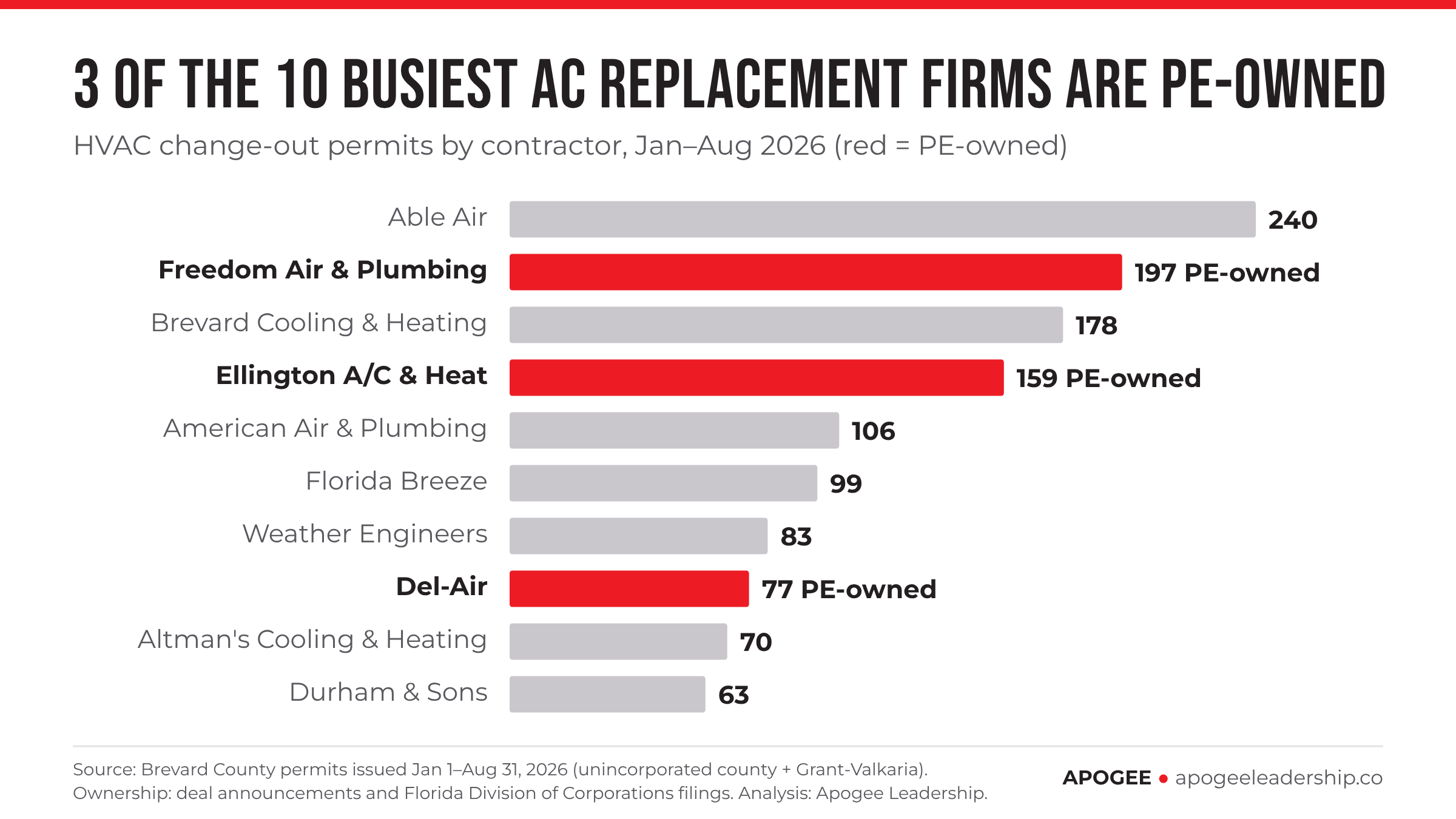
Among the 80 busiest Brevard-based contractors, three have been bought outright by PE-backed platforms. All three are HVAC companies, and all three still operate under their local names. Two more are local franchisees of national brands whose franchisor is PE-owned. Among the 35 busiest out-of-county firms working here, 12 are PE-owned, PE-backed or part of a PE-owned franchise system.
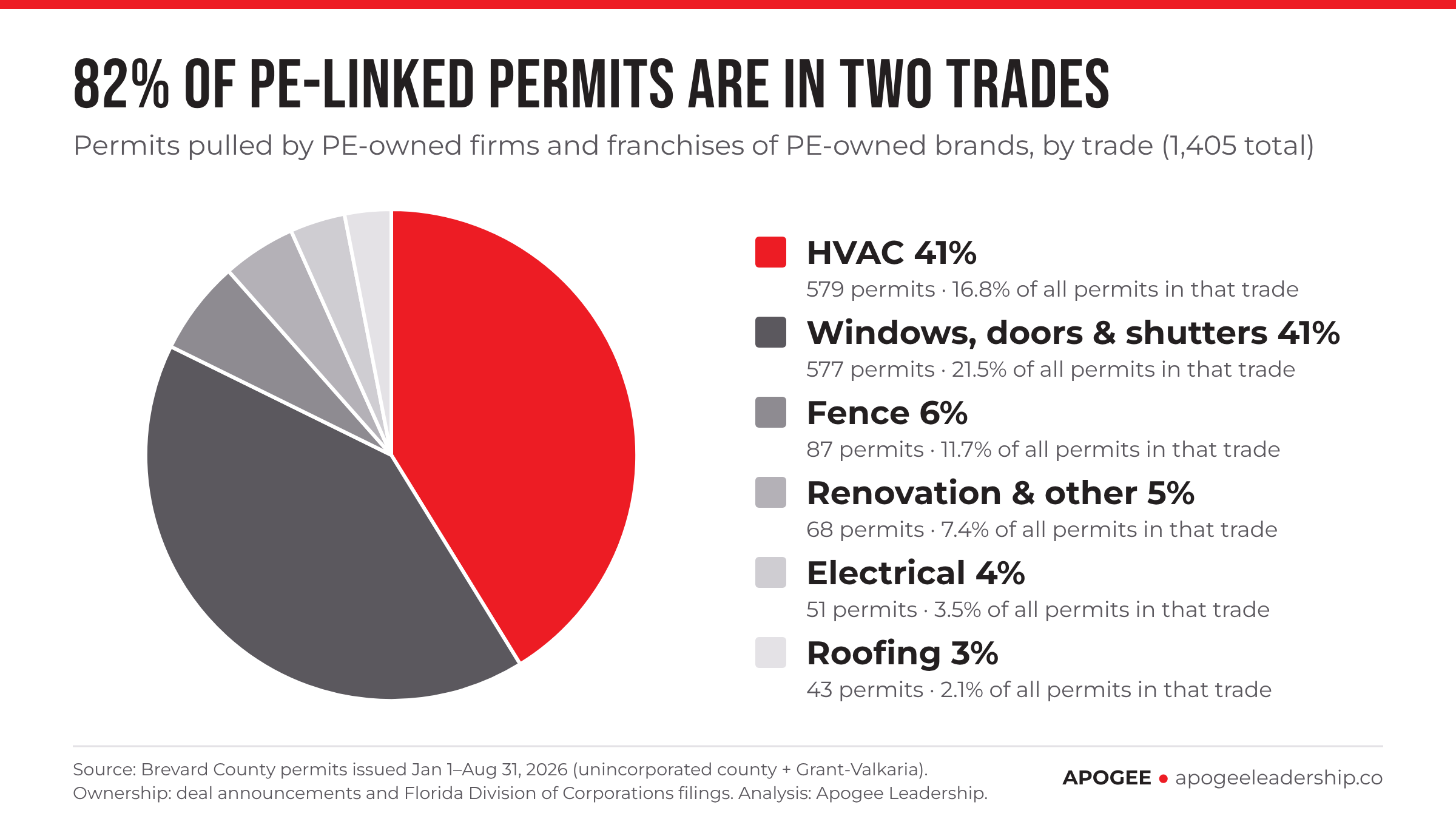
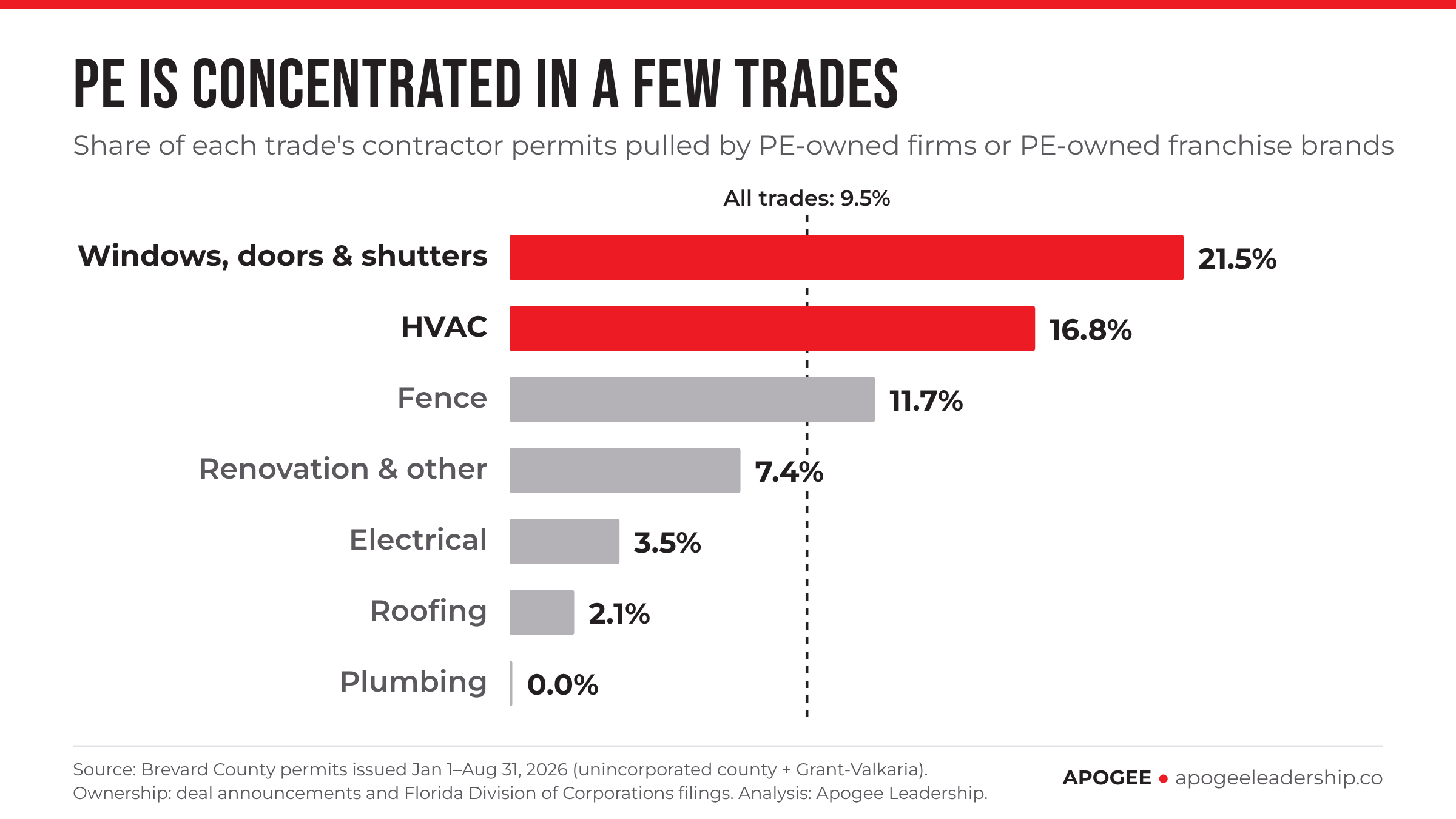
Add them up and 1,405 of the 14,755 contractor permits in the data, 9.5%, went to PE-owned firms or franchises of PE-owned brands. In windows, doors and shutters it was 21.5%.
| Company | Based | Main trade | Permits, Jan–Aug 2026 | Owner or backer | Since |
|---|---|---|---|---|---|
| Freedom Air & Plumbing | Rockledge | HVAC, plumbing | 206 | The Master Trades Group (L Catterton) | 2024 |
| Ellington A/C & Heat | Rockledge | HVAC | 159 | TurnPoint Services, owned by OMERS Private Equity since late 2020 | 2020 |
| Kabran Air Conditioning & Heating | Cocoa Beach | HVAC | 71 | Cascade Services, a platform formed by LP First Capital and Trive Capital | 2024 |
| Wallaby Windows of Melbourne | Melbourne | Windows | 110 | Local franchise. The franchisor, Wallaby Windows, was bought by Empower Brands (MidOcean Partners) | 2023 |
| Superior Fence & Rail of Brevard | Melbourne | Fence | 90 | Local franchise. The franchisor was bought by Outdoor Living Brands (MidOcean Partners) | 2021 |
| Power Home Remodeling | Chester, PA | Windows | 183 | Harvest Partners since 2022; Bain Capital and Sixth Street invested in 2026 | 2022 |
| Precision Garage Door of Brevard | Florida | Garage doors | 117 | Franchise. The franchisor was bought by Neighborly in 2020; Neighborly owned by KKR since 2021 | 2020 |
| Renuity | Fort Lauderdale | Windows | 84 | Greenbriar Equity Group | 2024 |
| Del-Air | Central Florida | HVAC | 79 | Astara Capital Partners, alongside Del-Air's employee owners | 2022 |
| ArmorVue and NewSouth | Florida | Windows | 73 | Window Nation (AEA Investors) | 2024, 2025 |
| Frank Gay Services | Orlando | HVAC, electrical | 49 | Apex Service Partners (Alpine Investors) | 2019 |
| 3MG Roofing | Winter Park | Roofing | 43 | Equity investment from a Bayview Asset Management fund | 2024 |
| West Shore Home | Mechanicsburg, PA | Windows, bath | 38 | Leonard Green & Partners | 2020 |
| Alpha Foundations | Monticello | Foundations | 37 | Groundworks (Cortec Group) | 2021 |
| Mid-Fla Heating & Air | Gainesville | HVAC | 36 | Cascade Services (LP First Capital, Trive Capital) | 2022 |
| Service Minds (Mister Sparky) | Southwest Florida | Electrical | 30 | Altamont Capital Partners; franchisor Authority Brands is owned by Apax funds | 2022 |
Ownership is shown as of the deal year. I found no later sale for any of these, but a fund's holding can change without an announcement.
The most telling finding is how I found them. Web searches turned up Freedom's sale, but missed Ellington and Kabran entirely. Florida's corporate records caught both. Each now operates through a Delaware company whose officers sit in Louisville, Kentucky and Dallas, Texas. A sale this size needs no press release. The paperwork is the only trace.
The rest of the story is just as important: 75 of the 80 busiest local contractors show no sign of outside ownership. Their officers are local names at local addresses. Brevard's trades are still mostly owned by people who live here. The question is for how long.
Beyond the trades
The trades are the only industry where I can count every job. Everywhere else, the only deals I can find are the ones someone announced, and there are already plenty. Since 2019, PE-backed buyers have bought or partnered with Brevard insurance agencies, wealth managers, a CPA firm, physician practices, a car wash, a landscaper and some of the county's best-known tech manufacturers.
| Business | Town | What it does | Buyer | Private equity behind the buyer | Year |
|---|---|---|---|---|---|
| Bill and Sheila Gaylor Insurance | Melbourne | Insurance agency | Keyes Coverage (Keystone Agency Partners) | Bain Capital; Warburg Pincus | 2023 |
| Suntree Insurance and A & C Insurance | Melbourne area | Insurance agencies | Keyes Coverage (Keystone Agency Partners) | Bain Capital | 2024 |
| FirstWave Financial | Satellite Beach | Wealth management | Savant Wealth Management | Kelso & Company (minority stake) | 2023 |
| Retter Capital Management | Melbourne | Wealth management | Mission Wealth | Great Hill Partners (minority stake) | 2025 |
| Berman Hopkins CPAs | Melbourne, Orlando | Accounting | Doeren Mayhew | Audax Private Equity | 2026 |
| Orthopaedics of Brevard | Rockledge | Orthopedic practice | Orthopedic Care Partners | Varsity Healthcare Partners | 2023 |
| Eight primary care offices | Brevard and Indian River | Primary care | Millennium Physician Group (Mosaic Health) | Clayton, Dubilier & Rice | 2026 |
| Flawless Lawncare & Landscaping | Brevard County | Landscaping | Juniper Landscaping | Bregal Partners | 2023 |
| Top Shelf Car Wash | Titusville | Car wash | Mister Car Wash | Leonard Green & Partners | 2019 |
| Brevard Rigging Supply | Cocoa | Industrial supply | Ascent Lifting | Shorehill Capital | 2025 |
| Aeronix Technologies | Melbourne | Defense electronics | ShoreView Industries, then Tinicum | ShoreView; Tinicum | 2021, 2024 |
| Sun Nuclear | Melbourne | Medical devices | Mirion Technologies | Charterhouse Capital Partners | 2021 |
| Brown and Brown Dentistry | Vero Beach | Dental | Today's Dental Network | HealthEdge Investment Partners | 2024 |
The gaps matter as much as the list. I found no announced Brevard deals for vet clinics, dental offices, physical therapy, child care or home health. Those are some of the most heavily bought industries in the country. A small clinic changing hands rarely makes the trade press, which is exactly the point of this article.
Wondering how much of this is true in your own company? The 5-minute assessment answers that — twenty questions, an eight-page report, no call required.
What it does to a local economy
The honest answer is that it depends on the deal, and the research cuts both ways. The largest U.S. study, covering about 9,800 buyouts from 1980 to 2013, found that employment rose 13% at privately held companies after a PE buyout, while it fell 13% at public companies taken private. Productivity rose about 8%. Pay per worker fell 1.7%.
That is the case for: a retiring owner gets a real exit, the business gets capital, and the jobs often grow. For an owner with no successor, a buyer at the door can be the difference between a payday and a closed shop.
The case against is about where the money goes afterward. A study of more than 11,000 European deals found that target companies cut their effective tax rates by about 15% after a PE deal without adding jobs, and that more PE activity went with lower local government tax revenue. The profit that used to be spent and banked in Brevard now flows to a fund. Decisions about wages and pricing move to a head office in another state. And the owner who sat on the chamber board and sponsored the Little League team is gone.
Brevard already has a version of this problem. The Build Report shows that 46% of permitted construction dollars in the covered jurisdictions already go to firms based outside the county. A PE purchase of a local leader moves that line without a single truck changing color.
One caution applies to all of it: nobody can measure this cleanly. Companies that fail after a buyout drop out of the data, and deals between small private firms are rarely announced. Anyone who tells you PE is simply good or simply bad for a town is selling something.
How a local business competes
A local business beats a platform by winning where money doesn't help, and by building the parts of a platform that cost nothing but discipline. The examples below come from the trades because that's where the data is. The same moves work for a dental office, an insurance agency or a vet clinic.
Own the demand. The permit data shows where outside firms win in Brevard, and it comes down to how the work is sold. They win the jobs that get sold: 95% of solar permits and 43% of window, door and shutter permits went to firms based outside the county. They lose the jobs people call about in an emergency: outsiders took 15% of HVAC change-outs and 3% of pool resurfacing. The platforms' real edge is a sales and marketing machine. A local firm that waits for the phone to ring is competing on the platform's terms.
Lock in the customer before the breakdown. Membership plans are central to how the big platforms sell. Champions Group, the platform Blackstone agreed to buy, has 150,000 members. A maintenance plan is the cheapest way to make sure that when the AC dies in August, the homeowner calls you first.
Be the employer good people want. Platforms run on skilled people, and in the trades, technicians are the scarcest thing there is. In veterinary medicine, the field PE has bought most heavily, 55% of vets say they'd rather work in private practice and 12% prefer corporate. A local owner who builds a real career path keeps the people a platform needs to poach.
Make "the owner answers" a promise you can keep. Local ownership is a selling point only if it shows up as faster decisions and someone who owns the problem. If every decision still waits on you, it's a bottleneck, and customers feel it.
Be the buyer. The same retirement wave that brings PE to town puts your competitors up for sale. A local owner with systems in place can buy a retiring neighbor's customers and crew. Another option is selling to your own employees: Del-Air was employee-owned before it took PE money.
Every one of these runs on the same thing: a business that works without you standing in the middle of it.
If you own a Main Street business
You will get the call, if you haven't already. Selling can be the right move. Whether it's a good sale comes down to one thing: whether the business runs without you.
A buyer is paying for what keeps working after you leave: the systems, the team, the recurring customers, the reputation. If all of that lives in your head and your cell phone, the buyer prices in that risk and you take their number. If it lives in documented processes and a team that makes decisions without you, you negotiate. You can also decide not to sell and keep a business that pays you without needing you there every day. I wrote more about that in Building a Business Worth Buying.
Here's what most owners never see from their side of the table. Once the deal closes, the buyer routinely brings in an operator, someone who does what I do, to spend the first year or two building the systems. That means documented processes, a leadership team that makes decisions without the founder, numbers reported the same way every month, and customers who belong to the company instead of the owner. The fund buys your company priced as a business that depends on you, builds the version that doesn't depend on anyone, and keeps the difference when it sells.
Venture capital does the same thing even earlier. Many VC firms keep operating partners on staff or push the founders they back into exactly this kind of work, often before the company is anywhere near a sale. A company that runs on systems is worth more and sells sooner, which pays its investors back faster. The people who make money when businesses sell already know what systems are worth. Most owners don't.
So the real question is who gets paid for building the systems: you, before the sale, or the fund, after it. In my experience, an owner who walks in with those systems already running can negotiate a buyout number as much as 30% higher, because the buyer has less to fix and less risk to price in.
I once worked with an owner who was badly hurt in an accident and out for more than a year. The owner came back to a business that had kept growing the whole time, because it had been built to run that way. That is worth building whether you ever sell or not.
If you want to know where your business stands today, start with the five-minute assessment.
For chambers and business groups
Every chamber in Brevard has members on all sides of this. Some are getting the call. Some are competing against companies that already took it. Many will sell in the next five to ten years whether they plan to or not, and most have never seen what's happening in their own county.
I talk with business groups about what the data shows, what buyers actually pay for, and what an owner can do now, whether they plan to sell, compete, hand the business down or simply step back. If your members would get something out of that conversation, let's set it up.
For presenters
This article is meant to be used. The charts are 16:9 images sized for slides, and the data behind them is in one spreadsheet. Use them freely with credit to Apogee Leadership and a link back to this page.
- Chart: 3 of the 10 busiest AC replacement firms are PE-owned (PNG)
- Chart: where PE-linked permits are, by trade (PNG)
- Chart: PE share of each trade (PNG)
- Data: the permit figures behind the charts, with a source for every contractor (CSV, opens in Excel)
If you'd rather have me present it, see the section above for chambers and business groups.
How this was done
- Permits: Brevard County's "Permits Issued Details" report, January 1 to August 31, 2026, by issue date. It covers unincorporated Brevard and Grant-Valkaria only, so contractors who work mostly inside cities look smaller here than they are. Owner-builder and government permits are excluded, which leaves 14,755 contractor permits. Firms are matched on state license number.
- Who was checked: The 80 Brevard-based contractors and 35 out-of-county contractors with the most permits. Together they pulled 48% of the contractor permits, so the 9.5% figure is a floor, and the full count is likely higher.
- Ownership: Each firm was checked against deal announcements and trade press, and against the Florida Division of Corporations bulk filing data (September 2026 extract) for out-of-state formation, out-of-state officers and corporate members. A firm is listed as PE-owned only where a published source names the buyer and the buyer's private equity backing.
- "No evidence" is not proof. Small private sales are often unannounced. Three firms here, Ellington, Kabran and Mid-Fla, were caught only because the state filings pointed to them.
- Franchises: Wallaby Windows, Superior Fence & Rail and Precision Garage Door are counted with PE because their franchisor is PE-owned. Their 317 permits are part of the 1,405. The local franchisee may still be locally owned.
NOT SURE WHERE YOUR CONSTRAINT IS?
Twenty questions about how your company actually runs, answered on your own. You get an eight-page report naming the one thing holding it back — five minutes, free, and you don't have to talk to anyone.
Rather just talk it through?
No pitch, no obligation. Reach me directly — messages come to me, not an assistant, and I reply within one business day.
ONE EMAIL A WEEK, FOR OWNERS
Apogee Insights is a weekly note for owners carrying things they can't put down. Free. Leave anytime.
Brian Vinci
Certified Pinnacle Business Guide · Founder, Apogee Leadership
Brian guides owners and leadership teams on Florida's Space Coast in building an operating system shaped around how their business actually works.

Tags
RELATED ARTICLES
I got told to "manage up"
They took a real problem to their company's leadership coach: decisions that don't hold, a boss who goes quiet when the news is bad. The coach told them to learn to manage up, and delivered it like a gift. Here is what that actually costs the person doing it, and what it says about the owner who lets it happen.
The team tried. That's what made it worse.
I get asked a lot whether I'll coach the employees. Or one department. Sales, usually. I don't, and I won't. Sixty days after the workshop the team is back to baseline, and they are worse than where they started, because they tried.
What My AI Agent Did While I Was on Vacation
I built an AI agent to run part of my business. Then I went on vacation and it silently stopped — for five days. Two failures, one management lesson, and the list I'd want in place before trying again.